How can contemporary design honour the past while creating something entirely new? For architect and designer DaeWha Kang, the answer begins with uncovering what makes a place special and imagining what it could become. From interventions in historic buildings to immersive exhibitions at Oxford’s Ashmolean Museum, his work explores the meeting points between heritage and innovation, architecture and art, expressive form and quiet contemplation.
In this spotlight, Amanda Gray, Partner in Mishcon Private, speaks to DaeWha about designing spaces that move us, the creative possibilities of collaboration and why good architecture must look beyond opening day.
Your studio is well known for its design of permanent spaces spanning the Black Gold Museum, the OWO Pavilion and St Andrew Holborn. These projects are all very different. How do you approach them?
St Andrew Holborn is a 350-year-old church designed by Christopher Wren. The Old War Office is 120 years old. And the Black Gold Museum was originally designed by Zaha Hadid fifteen years ago. In all of these projects, our studio needed to find the essence of what made the existing building special, and to find the hidden potential that could be unlocked with our own very contemporary interventions. In each case the ultimate result is different, but that process of peeling away the layers until the essence of the original architecture remains, and then rebuilding into something completely reimagined, is the core of our approach.
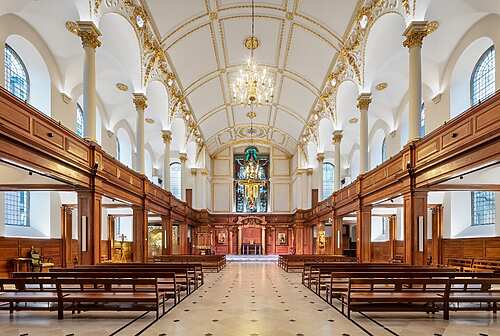
St Andrew Holborn. Courtesy: Kyungsub Shin
The Black Gold Museum had great structural bones, but we completely rearranged all of its circulation, created new grand spiral staircases, and made totally new galleries in what used to be a research library, now becoming a major contemporary art museum. In the Old War Office, it was very much about creating new sculptural architecture in the pavilion and the fountain, and rearranging the historic cobblestones to integrate with new planters and the new architecture to create a dynamic but harmonious whole. And at St Andrew’s, it was about taking away the clutter that had accumulated over the decades and finding a new sense of spirituality, with absolutely cutting-edge contemporary design meeting Wren’s architecture side by side.
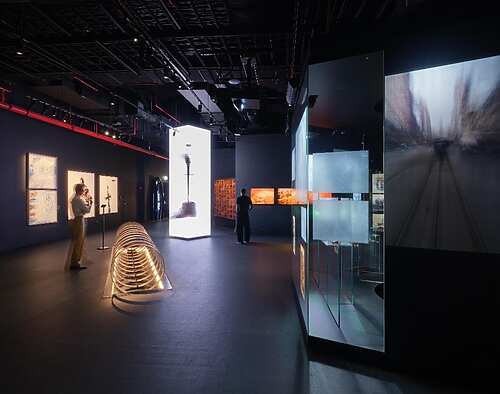
Black Gold Museum DaeWha Kang Design Credit: Hassan al Shatti (06 Encounter)
Layering of forms, materials and textures seems to be significant in your work. Is that correct?
We do take great pleasure in expressive forms and spaces in our architecture. Ultimately, it is the form and the space that modulates the light, that creates the inhabitable moment, that feeling of the relationship of ourselves as human bodies moving through architecture and urban spaces. But we design for the human experience of those spaces not only on day one, but over the longer term. Looking at how buildings and spaces age, it often is the articulation, the richness and the texture that let them age gracefully. A minimalist white wall might look great on opening day, but over the course of time, with all of the wear and tear that comes with years of inhabitation, I believe natural materials, textured materials, layers of articulation and pattern — like what you see in the grand spiral of the Black Gold Museum, or in the stone floor of St Andrew’s, or the rippling mirror stainless steel in the Old War Office — can better stand the test of time.
What influences your work?
I find great inspiration from my role as an architect, negotiating what came before with what is yet to come. I love introducing contemporary architecture into historical spaces, but even when creating work in nature or in new spaces, there is that feeling that something was there before, that there’s a presence of the past, and that what I’m doing is creating a transformation that projects us into the future.
With that in mind, I’m always looking for the meaning in our work: bringing forward history and heritage, or creating these new identities that will have lasting significance for the people who experience the architecture today, tomorrow, and in the long and distant future.
There’s a sustainability angle to that as well. Because I love thinking about the long term, I often find myself thinking about the life and the afterlife of my architecture, even when we are in the process of creating it now. So I think about how our buildings can be maintained, how they can come apart later, and how they can be relocated if needed. The Old War Office Pavilion, for example, can be completely picked up and moved — it’s all made from modular parts. And the Black Gold Museum works with all of its existing structure, adding only 6% new primary structure. Although we’ve completely changed the character and the flow of the space, that basic structure still remains as a trace of what came before in Zaha Hadid’s building.
I do believe in human beings’ primal need to connect with nature, and always seek to bring in natural materials with their richness and texture, and the patterns and forms of nature as well, which I think helps our buildings age gracefully.
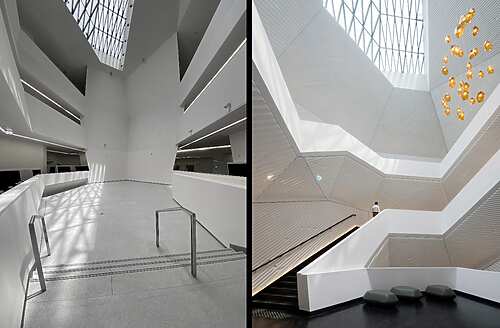
DaeWha Kang Design: Black Gold Museum, Before and After. Credit: Hassan Al Shatti
What is the impact of good design?
Good design unlocks unexpected value. It often comes from the beautiful friction between contrasting elements: the tension between past and future, the intersection of richness and calm. In the Old War Office Pavilion, you see extremely expressive sculptural architecture and landscape design, but the overall effect is one of tranquillity. That tension is something that we feel, and it’s something difficult to achieve — how we make something that’s both appropriate to the space and deferential when needed, but still so striking and unforgettable.
When design does its job well, we find it’s possible to create these moments that no one would have expected. We’ve managed to do that with In Bloom at the Ashmolean. The garden room fills with dappled light, the translucency and lightness of the fabrics hanging, the immersiveness of the green colour. Somehow it has a powerful atmospheric effect while still leaving so much space for the artworks to speak for themselves.
You recently designed the exhibition schemes for In Bloom and Aphrodite at the Ashmolean, Oxford. Talk us through the journey from concept to delivery.
The Ashmolean is a fantastic and very experienced client. The design process we have with them is deeply collaborative. We work with their curators and their project management team, holding the final visitor experience in every decision from the very beginning of our process. With the curators, we establish which key objects will inspire visitors. From those stories, we extract the essence of the feeling the spaces need to convey.
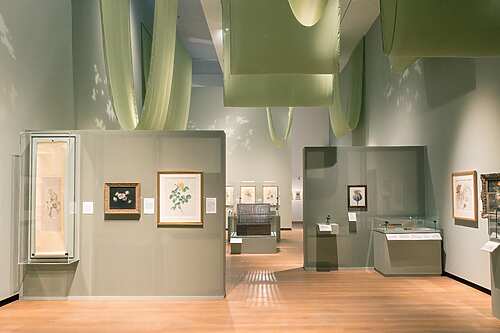
Ashmolean In Bloom. Credit: Hannah Pye
For In Bloom, it was a luminous garden that anchored the space. For Aphrodite, we had spaces reaching back through the mists of time to old legends, while we also had Renaissance and contemporary works, opening up new perspectives and vantage points on those pieces, which led to an unusual series of portals juxtaposing old and new visually.
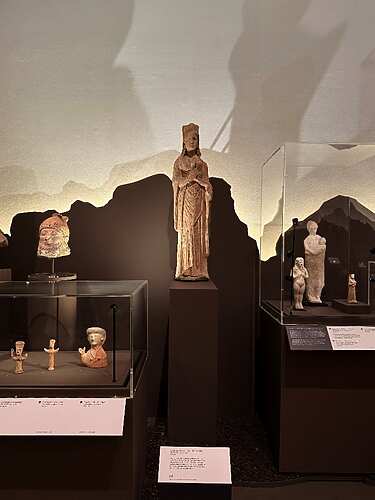
Ashmolean Aphrodite. Credit: DaeWha Kang Design
Museum projects are complex: curation, interpretation, communications, marketing, conservation, and all the usual demands of safety and security. Much of the work is bringing those stakeholders together. The skill is in finding simple, powerful spaces that make all of that complexity invisible.
Our work continues after the build as well. Talks that support visitor engagement, and troubleshooting elements that behave differently once real visitor numbers arrive. On larger gallery and museum refurbishments, like the Black Gold Museum, we stay close to the client to iron out the wrinkles that always appear once the keys have been handed over.
From a legal perspective, how was the relationship contractually framed? We work with creatives and artists on commissions, structuring deals that often are a balance of competing interests. Is your experience similar?
Consultant appointments are usually direct with the museum client. On very large projects, our client might be government directly — a museum commissioned through a ministry of culture, for example.
Intellectual property is always an important aspect of design relationships. We aim to find a position where everyone’s needs are met. Architects and creatives will always want to preserve their right of authorship and their intellectual property, while clients, especially in the cultural sector, want as much flexibility as possible to use images and the designs themselves. Having a good legal framework helps to navigate that complex relationship more smoothly. We always like to approach the legal aspect with the long-term relationship in mind, so there can be give and take, and it does help to have legal support to negotiate.
Sometimes we work with pure sculpture or art pieces that we also produce, and there the liability is greater — public safety, product liability, and the greater financial risk of taking on the entire production cost contractually. Handling that process is certainly more complex and needs to be well structured.
Is design of a temporary exhibition different in process to design of permanent structures? Do you collaborate with the curators and/or respond to the objects being exhibited?
D: Yes, temporary exhibition design is faster paced and offers different opportunities from fully permanent architecture. Designing galleries for permanent display puts more weight on future flexibility: how the infrastructure of the museum works, how lighting and environmental services are arranged, and whether the space is a good container for many different kinds of display, both for today and for tomorrow. Whereas a temporary show lets us go for a much bolder experience and lean into deeply immersive spaces.
We often follow a more linear narrative with temporary exhibitions, because they usually have a focused topic that is relevant for a six- or nine-month run, whereas permanent exhibitions often have a broader collection that people may dip in and out of when they visit. Both demand close collaboration with curators, and we always think deeply about the objects on display, particularly the star objects that anchor the space and give rhythm and pacing to the experience of the visitor.
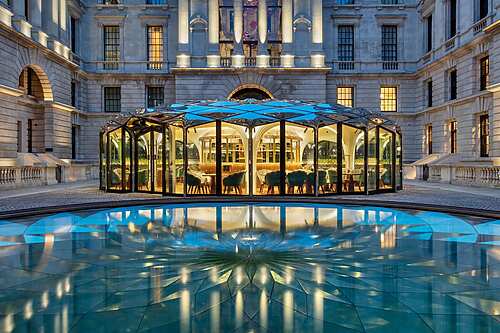
OWO. Credit: Kyungsub Shin
Your team have a strong relationship with Oxford. Does the sense of place direct your work? What does Oxford mean for you?
The Ashmolean is a wonderful client, particularly for the intellectual rigour they bring to every project we have designed with them. That scholarly focus, that deeper curiosity, opens up design possibilities. It’s a pleasure to bring them to life in physical form, as we did with In Bloom and Aphrodite.
Oxford is an extraordinary place to have access to, this concentration of culture and thought in one place. It’s close to London, yet far enough away to hold a character of its own. I feel an expansiveness of possibility when I’m there, more perspective, more distance from the hustle and bustle of London.
I also love the boldness of Oxford’s architecture. In every era, they’ve just gone for it — centuries ago, in the 20th century, and in what is being built now. There is a spirit of exploration and a willingness to take risks in commissioning architecture. You don’t always get it right, but you have hundreds more years to keep evolving and refining it. That tension between enormous heritage right next to a real appetite for contemporary and new thinking is something we love. You can see how we’ve brought it into the Old War Office Pavilion and St Andrew Holborn, contemporary design brought into deeply historic settings.
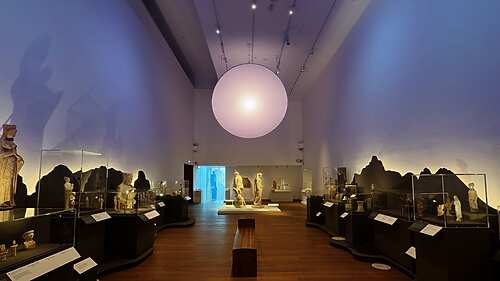
Are you seeing a developing overlap between fine art and design?
Yes, we are increasingly asked to make sculptures with inspiration drawn from our architectural interests. And it’s true that some of our architecture could fairly be called sculptural, the Old War Office Pavilion being a good example of that.
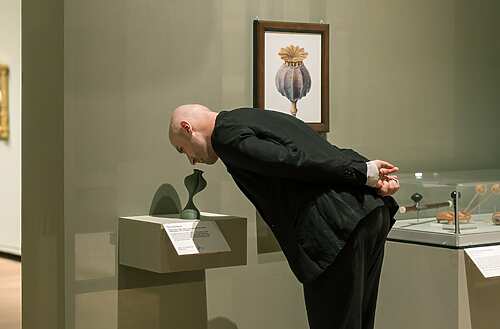
For the Ashmolean, we made sculptural vessels inspired by the opium poppy, the tea flowers and the rose, 3D printed in bioplastic. These were used for carrying the multisensory smell experiences for our visitors. One of those forms, the opium poppy, we took further and cast in bronze. People have been collecting them, and there is something different that happens when design moves into a proper sculptural realm with permanent materials like bronze.
For St Andrew’s, although we were the architects, we also designed the reredos behind the altar, the sanctuary lamp and the tabernacle. These are properly artistic, sculptural pieces. And we continue to develop keepsakes and sculptures for international clients with an affinity to the architecture, although once you move into artistic creation, the narrative has to come from a different place.
I think that this blurring of art and design is intriguing. It allows us to be an outsider in the architecture world and in the art world, or an insider at the same time. I believe that creative disruption is something that adds great value and interest, and I hope these trends continue.
You set up your studio in 2014. What are the challenges for creative start-ups? How are lawyers best placed to help?
D: One of the biggest challenges for creatives starting up enterprises is that the purity of intention, the artistic question that burns inside us, needs to lead us where we’re going. Without that, we lose our North Star. But ultimately we have to deal with the challenging questions. Should we take investment, or should we self-fund and grow more slowly? How do we balance commercial risk, cash flow and liability — all of these real dangers — without extinguishing the creative flame?
A good contract smooths and protects the relationship between a creative and a commissioning body through the inevitable bumps in the road. Part of the journey of creative enterprise is one of growth, and good lawyers have been essential to helping us identify the few absolutely critical risks that are real, versus the nice-to-haves that we can easily compromise on to move an appointment along.
For us as creatives, it is critical to have a safe space to operate. It’s not always easy to understand how much limitation of liability we are willing to take on in our contract terms, or how firm to be on intellectual property rights with big clients or government clients with standard contract terms. A good lawyer will be lean, and will help us deal with those absolutely critical things and not get us bogged down in costly evaluation of a lot of the other detail.
What is next for your studio?
We are designing an exhibition at a major London museum, set to open in Autumn 2027. We also continue with cultural and hospitality work in the Middle East, the UK and Europe, as well as the Far East.
I’m most excited by the two extremes at once. We have some exquisite small sculptural keepsakes that we are designing right now — wonderfully expressive and absolutely beautiful. And we have some large-scale master planning and architecture work that is at the scale of districts and pieces of city. It’ll be fascinating to see how the ideas that you can see in our individual projects, like St Andrew’s, the Old War Office Pavilion, or the Ashmolean galleries, translate at that scale.
We continue our work in adaptive reuse, regenerative design and sustainability. We have research projects brewing about reusing concrete from existing buildings where the concrete is coming to end of life, and turning this into new building materials for new buildings. It’s going to be an exciting 2027.
How Mishcon de Reya can help
Our specialist Art Law team advises collectors, artists, galleries, dealers and institutions on the legal issues involved in creating, owning and dealing in art. We support art sales, purchases, loans, consignments and financing, alongside collection and estate planning, intellectual property protection and regulatory compliance. We also resolve disputes concerning title, provenance, authenticity and attribution, and advise on cultural heritage and restitution claims. With extensive international connections, we handle complex cross-border matters with discretion and sensitivity to reputation and legacy.